Troubleshooting
Single Channel vs Dual Channel ABS Sensor Troubleshooting & Brake Bleeding Secrets

Braking System Specialist
24 July 2026
6 min read
Understanding Anti-Lock Braking Systems (ABS) in Motorcycles
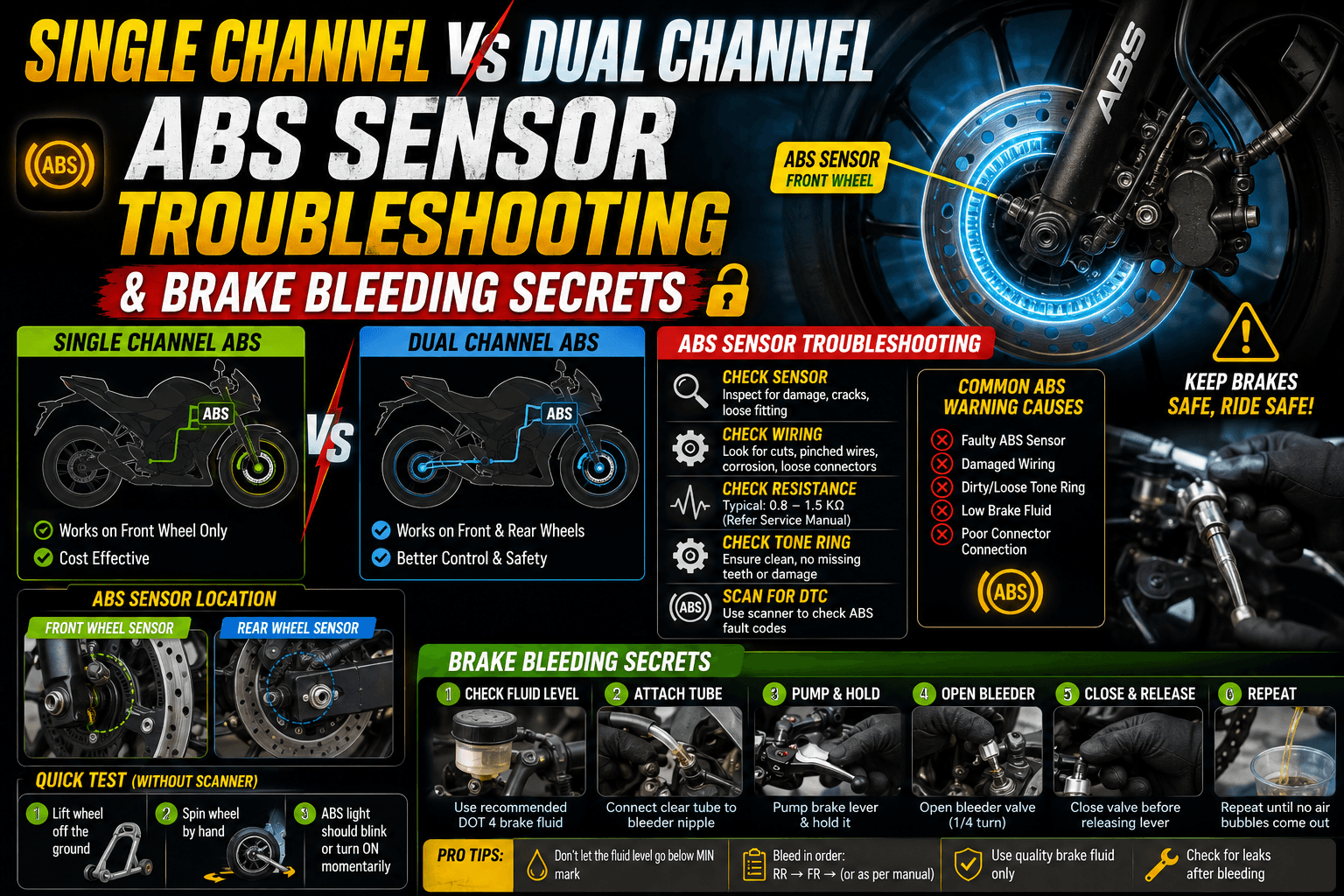
Modern 125cc+ motorcycles in India come mandated with Single Channel ABS (front wheel only) or Dual Channel ABS (front & rear). When the ABS light stays permanently illuminated above 10 km/h, the ABS unit has detected a fault and disabled anti-lock protection.
Top Causes of ABS Fault Light Illumination
- Wheel Speed Sensor Air Gap Incorrect: Sensor tip must be positioned 0.5 mm - 1.5 mm away from the pulsar ring. If bent, clean or adjust shim thickness.
- Metallic Dust / Mud on Magnetic Sensor Tip: Magnetic pick-up collects metal shavings, corrupting pulse signals. Clean with isopropyl alcohol.
- Pulsar Ring Bending or Missing Teeth: Impact from stones or tyre levers can warp the slotted encoder ring.
- Low Brake Fluid Level or Air Trapped in ABS Modulator: Low DOT4 fluid triggers hydraulic pressure faults.
The Pro Method for ABS Hydraulic Brake Bleeding
Standard pump-and-bleed methods often fail to remove trapped air bubbles from the internal ABS hydraulic valve block. Follow this procedure:
- Use fresh DOT 4 synthetic brake fluid from sealed containers.
- Attach a vacuum brake bleeder tool to the caliper bleeder nipple.
- Maintain constant fluid level in the master cylinder reservoir to prevent drawing in new air.
- Cycle the ignition key to activate the ABS self-check pulse during final bleeding steps.
Find genuine disc pads, master cylinder repair kits, ABS sensor cables, and DOT 4 brake fluids on MecSpot.
Need Quality Bike Tools & Parts?
Discover our wide range of authentic motorcycle tools and spare parts trusted by mechanics across India.
Shop NowNever Miss a Post
Subscribe to our newsletter for expert tips on bike maintenance and product launches.